Introduction
Modular blockchain is a hot issue in the conversation of crypto lovers today, seeing the existing blockchain problems. The problem with the monolithic blockchain so far is due to its scalability which is considered unable to be improved because it is single in executing transactions. The modular blockchain is here to solve this problem.

One of the modular blockchains that comes with this problem is celestia. Celestia comes as a modular blockchain from a different perspective. Celestia provides the Execution layer and only provides the base layer for Data Availability. This is what makes Celestia provide security for rollups/appchains on a very high scale. Also, this means Celestia is focusing on a single element of the blockchain stack, which may be more effective than a multipurpose approach.
In addition, according to CEO Celestia, Mustafa Al-Bassam said that Web3 will not be scalable within the constraints of a monolithic framework. We envision a blockchain ecosystem with layers of modular data availability and execution environments all integrated together. We believe modular blockchain is the next generation of scalable blockchain architecture.
Celestia Raises $55M
Through of this different approach, Celestia through the Celestia foundation won the trust of investors by obtaining project funding worth US $ 55 million led by Bain Capital Crypto and Polychain Capital (19/10/2022). Apart from that, several investors were also involved, including Placeholder, Galaxy, Delphi Digital, Blockchain Capital, NFX, Protocol Labs, Figment, Maven 11, Spartan Group, FTX Ventures, Jump Crypto, as well as a number of angel investors such as Balaji Srinivasan, Eric Wall, and Jutta Steiner.
Celestia Ecosystem
Several modular blockchain projects have also entrusted and chosen celestia as their data availability layer such as Caldera, Astria, Eclipse, Constellation, and dYmension. Celestia’s thriving ecosystem is claimed to attract a number of projects including rollups, infrastructure rollups, decentralized finance (DeFi) applications, and many more. Currently, they are developing 26 projects in Modular Fellows which is Celestia’s new program to support and guide modular development.
Analysis Testnet (Light Node)
According to the author’s observations, among several nodes that have been followed, Celestia is indeed unique because it is so light, it does not require large resources, for example other blockchains that require up to 10 cores 32 Ram and 1 T Storage or the lowest so far 2 cores 4 Ram and 100 SSD. In Celestia you jusr need 1 Core, 2 Ram and 50 SSD, isn’t it light?
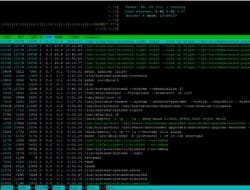
Since deploying a node on Celestia using a server with a capacity of 4 cores 8 ram and 160 SSD through the screenshot above it shows that CPU usage is only around 4-18% and for memory the average usage is from 28%.

And it is also observed that the connection is also very stable as shown in the image below using the command: nethogs. With the conclusion that the testnet on the Celestia network is very easy and not much complicated where we only need to update the guess node without having to experience a crush because the standard or specification of the device used to participate in the light node testnet is also very light.